AI writing tools have become a standard part of content creation, spanning categories from SEO optimization and blog writing to marketing copy, academic research, and creative fiction. The market now includes dozens of platforms, each built with different strengths and target users in mind.
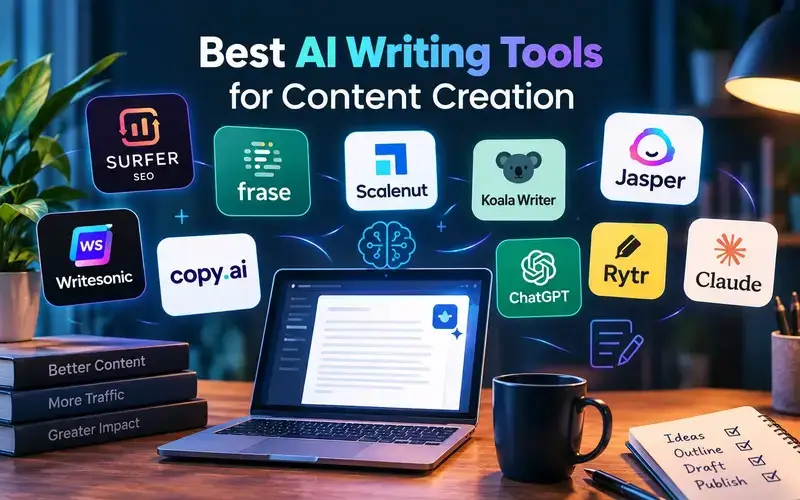
Choosing the right tool depends on the specific writing task at hand. Some platforms excel at generating SEO-friendly content, while others focus on refining grammar and style or supporting long-form fiction. A closer look at the leading options, how they compare, and which use cases they serve best can help writers and businesses make an informed choice.
What Are AI Writing Tools?
AI writing tools are software platforms that rely on large language models to generate, refine, and organize written content. They serve professional, academic, and creative purposes.
These platforms run on underlying models, including GPT-4o from OpenAI, Claude Sonnet 4 from Anthropic, and Gemini 1.5 Pro from Google DeepMind.
Most AI writing tools perform four core functions:
- Content generation – producing drafts from prompts
- SEO keyword optimization – aligning text with search intent
- Grammar correction – catching errors and improving clarity
- Tone adjustment – matching voice to audience or purpose
Jasper, Writesonic, and Copy.ai connect to the GPT-4o API to generate drafts. Surfer SEO and Clearscope add NLP-based content scoring on top of that generation process.
Best AI Writing Tools: Quick Comparison Table
Pricing, model type, and free plan availability vary widely across the AI writing tool market. The table below summarizes the key details for each platform at a glance.
| Tool | Best For | Starting Price | Free Plan | AI Model | G2 Rating |
|---|---|---|---|---|---|
| Surfer SEO | SEO content scoring | $89/mo | No | Proprietary NLP + GPT-4 | 4.8/5 |
| Frase | SEO briefs & drafts | $45/mo | No ($1 trial) | GPT-4 | 4.8/5 |
| Scalenut | SEO planning | $39/mo | No (7-day trial) | GPT-4 | 4.7/5 |
| Koala Writer | Bulk blog content | $9/mo | No | GPT-5.6+ Claude Sonnet | 4.6/5 |
| Jasper | Marketing & long-form | $49/mo | No (7-day trial) | GPT-4o + Claude | 4.7/5 |
| Writesonic | Blog posts & web-sourced content | $16/mo | Yes (25 credits) | GPT-4o | 4.7/5 |
| ChatGPT | General-purpose writing | $20/mo (Plus) | Yes | GPT-4o | 4.7/5 |
| Copy.ai | Go-to-market & email workflows | $49/mo | Yes (2,000 words) | GPT-4o | 4.4/5 |
| Anyword | Predictive ad copy | $49/mo | No (7-day trial) | GPT-4o | 4.8/5 |
| Claude | Long-form & academic writing | $20/mo (Pro) | Yes | Claude Sonnet 4 | 4.7/5 |
| Rytr | Budget-friendly writing | $9/mo | Yes (10k characters) | GPT-3.5/4 | 4.7/5 |
| GravityWrite | Template-based content | $19/mo | Yes (1,000 words) | GPT-4o | 4.5/5 |
| Sudowrite | Fiction & creative writing | $19/mo | No (3-day trial) | Claude + GPT-4 | 4.5/5 |
| Notion AI | Document writing | $10/mo add-on | No | Claude + GPT-4 | 4.7/5 |
| Grammarly | Grammar & editing | $12/mo | Yes | Proprietary + GPT-4 | 4.7/5 |
| QuillBot | Paraphrasing | $13.33/mo | Yes (125 words) | Proprietary | 4.6/5 |
| Hemingway Editor | Readability editing | $19.99 one-time | Yes (web version) | Rule-based | 4.4/5 |
| Clearscope | Content grading | $189/mo | No | Proprietary NLP | 4.9/5 |
Several patterns stand out. Tools built for SEO work, such as Surfer SEO and Clearscope, tend to carry higher price tags and skip free tiers entirely.
By contrast, general writing assistants like ChatGPT, Claude, and Grammarly offer free access, making them accessible starting points. Budget options such as Rytr and Koala Writer deliver GPT-based output at a fraction of the cost of premium marketing suites like Jasper or Anyword.
Best AI Writing Tools for SEO Content
Four platforms stand apart for SEO content work: Surfer SEO, Frase, Scalenut, and Koala Writer. Each ties keyword analysis, NLP scoring, or live search data directly into the writing process. This distinguishes them from general-purpose writing assistants, which produce text without checking it against actual search results.
Surfer SEO
Surfer SEO evaluates written content against more than 500 NLP signals pulled from the top 20 pages ranking for a target keyword. It assigns each piece a Content Score from 0 to 100. Based on the company’s own correlation data, content scoring above 67 reaches Google’s first page at a rate 3.5 times higher than content scoring below 40.
The tool connects with Google Docs and WordPress through a Chrome extension, allowing writers to see scores update as they edit. It carries a 4.8 out of 5 rating across 528 verified G2 reviews.
Pricing: Discovery: $49/month – Standard: $99/month – Pro: $182/month, No free tier offered
Strengths:
- Grades content using over 500 NLP signals drawn from live SERP data
- Works within Google Docs, WordPress, and Jasper
- Bundles SERP Analyzer, Keyword Research, and Topical Map features
Limitations:
- Charges an additional $29/month for AI draft generation
- Caps the Essential plan at 30 articles monthly
- Requires pairing with another tool for full draft writing
Frase
Frase compiles SEO briefs by pulling data from the top 20 URLs ranking for a chosen keyword. It tracks four metrics per competitor: word count averages, heading structure, People Also Ask questions, and topic coverage. Its Answer Engine feature identifies 10 to 15 relevant PAA questions per keyword without manual research. Frase holds a 4.8 out of 5 rating from 321 verified G2 reviews.
Pricing: Solo: $45/month – Basic: $115/month – Team: $149/month, 5-day trial available for $1
Strengths:
- Generates content briefs from live SERP data in under a minute
- Pulls PAA questions automatically through the Answer Engine
- Compares drafts against competitor content as writers work
Limitations:
- AI-generated drafts typically need substantial editing before publishing
- Reserves bulk content generation for higher-priced plans
- Provides no free plan; trial access requires payment
Scalenut
Scalenut brings keyword clustering, content planning, AI drafting, and on-page optimization together in a single interface. Its Cruise Mode feature produces a structured, 1,500-word draft in about five minutes, following a five-step sequence: keyword entry, outline creation, NLP term selection, drafting, and Content Score generation.
Pricing: Essential: $39/month – Growth: $79/month – Pro: $149/month, 7-day free trial available
Strengths:
- Automates a five-step drafting process in under five minutes via Cruise Mode
- Includes keyword clustering alongside topical planning tools
- Handles multilingual SEO projects across 40+ languages
Limitations:
- Requires manual fact-checking of generated content
- Presents a steeper learning curve compared to tools like Jasper or Writesonic
- Offers fewer integrations than Surfer SEO
Koala Writer – visit >
Koala Writer produces long-form SEO articles of up to 6,000 words using GPT-4o. It grounds content in real-time Google search results and Amazon product data to improve accuracy around entities and facts.
At $9 per month for 15 articles, it offers the lowest per-article cost among the tools covered here.
Pricing:
- Starting tier: Starter $9/month (1,5000 words)
- Top tier: Elite $350/month (2,500 articles)
- No free plan
Strengths:
- Costs as little as $0.60 per article on its entry-level plan
- Uses live search data to support factual accuracy
- Publishes directly to WordPress without manual uploading
Limitations:
- Needs a separate tool for NLP-based content scoring
- Fits long-form SEO work better than short marketing copy or email writing
- Has a smaller template selection than competitors like Jasper or Writesonic
Best AI Writing Tools for Content & Blog Writing
Jasper, Writesonic, and ChatGPT stand out as the strongest options for producing blog articles and marketing content at scale. Each platform supports long-form drafting, multiple tone settings, and brand voice consistency, making them suitable for teams that publish content regularly.
Jasper
Jasper builds long-form blog posts, product descriptions, and ad copy by running GPT-4o and Claude Sonnet together as its core models. Its Brand Voice feature can be trained on up to three uploaded company documents, allowing output to match an established tone. G2 reviewers give Jasper a 4.7 out of 5 rating across 1,233 verified reviews, and the platform offers more than 50 content templates.
Pricing: Creator: $49/month – Pro: $69/month – Business: custom pricing, a 7-day free trial is available
Strengths:
- Maintains consistent tone across more than 30 languages through Brand Voice training
- Offers over 50 templates spanning blog posts, social captions, and email copy
- Connects with Surfer SEO, Google Docs, and Grammarly for streamlined editing
Limitations:
- Cannot pull real-time web data without a separate browser integration
- Costs more per word than comparable tools like Writesonic or Rytr
- Provides no free tier beyond the initial 7-day trial
Writesonic
Writesonic produces blog posts, landing pages, and product copy using GPT-4o, while its Chatsonic feature adds live Google search access to improve factual grounding. Article Writer 6.0 pulls from real-time search results to generate citation-backed articles. It holds a 4.7 out of 5 G2 rating from 1,946 verified reviews, the largest review count among the tools covered here.
Pricing: Free plan: 25 generation credits per month – Individual: $16/month – Standard: $79/month – Enterprise: custom pricing
Strengths:
- Includes a usable free tier with monthly generation credits
- Bases Article Writer 6.0 output on live search data for improved accuracy
- Combines real-time search through Chatsonic within one platform
Limitations:
- Uses up free credits quickly, often within one or two long-form articles
- Shows uneven quality between short-form and long-form content
- Tracks Chatsonic usage separately from standard generation credits
ChatGPT
ChatGPT handles blog outlines, full drafts, social posts, and email content through GPT-4o, with its Projects feature retaining custom instructions and brand details across sessions. It carries a 4.7 out of 5 G2 rating based on 659 verified reviews.
Pricing: Free plan: GPT-4o mini access – ChatGPT Plus: $20/month with full GPT-4o access – ChatGPT Pro: $200/month
Strengths:
- Delivers meaningful writing capability even on the free tier via GPT-4o mini
- Accepts multimodal input, including images, PDFs, and spreadsheets, through GPT-4o
- Allows in-editor drafting and revision through the Canvas feature
Limitations:
- Lacks built-in SEO scoring or keyword optimization tools
- Depends on manually enabled web browsing for accurate, current information
- Produces less consistent results on the free tier compared to paid plans
Best AI Writing Tools for Marketing & Copywriting
Marketing teams looking for AI-driven copywriting support have several strong platforms to choose from. Two options stand out for different reasons: one focuses on workflow automation, the other on predicting how copy will perform.
Copy.ai
Copy.ai builds on GPT-4o to generate sales email sequences, blog drafts, and product descriptions. Its GTM AI Workflows feature links multiple prompts together, allowing teams to run full content pipelines that connect directly to CRM platforms like HubSpot and Salesforce.
On G2, Copy.ai carries a 4.4 out of 5 rating based on 172 verified reviews. The free tier includes 2,000 words per month.
Pricing: Free: 2,000 words/month – Starter: $49/month – Advanced: $249/month – Enterprise: Custom pricing
Strengths:
- Free plan available for smaller copywriting needs
- Chained workflows support multi-stage content campaigns
- Direct integration with HubSpot and Salesforce
Limitations:
- Blog content quality trails behind competitors such as Jasper or Writesonic
- Workflow builder can be difficult for users without technical experience
- Free plan’s word limit restricts regular professional use
Anyword
Anyword takes a different approach by scoring every piece of copy it generates with a Performance Prediction Score ranging from 0 to 100. This score estimates likely conversion performance before the content goes live, based on a model built from more than one billion samples of marketing copy.
Anyword holds a 4.8 out of 5 rating from 1,038 verified G2 reviews, the strongest rating among tools compared here.
Pricing: Starter: $49/month – Data-Driven: $99/month – Business: $499/month – Trial: 7 days free
Strengths:
- Assigns a predictive performance score to every output
- Built on a large dataset of real marketing copy results
- Offers over 200 templates spanning email, ads, and landing pages
Limitations:
- Costs more per output compared to Copy.ai at similar volumes
- No permanent free plan, only a short trial period
- Prediction accuracy is strongest for English-language content specifically
Best Free AI Writing Tools
Several AI writing platforms offer no-cost plans that handle real writing tasks, from long articles to short marketing copy. Each tool has distinct strengths depending on document length, formatting needs, and content type.
Claude (Free Tier)
Claude’s free tier runs on Claude Sonnet 4 and handles long-form articles, email drafts, and structured academic writing. It supports a 200,000-token context window, allowing users to upload full research papers or lengthy documents for analysis and rewriting.
Anthropic reports that Claude Sonnet 4 scores 88.7% on the MMLU benchmark, a measure of factual accuracy across subject areas. Stanford CRFM’s HELM benchmark also ranked Claude Sonnet as the top performer for instruction-following on structured document tasks in early 2025.
Pricing: Free: $0 (Claude Sonnet 4) – Claude Pro: $20/month – Claude Max: $100/month
Strengths:
- Large 200,000-token context window on the free plan
- Strong benchmark performance for accuracy and instruction-following
- Produces well-organized documents with clear heading structure and logical flow
Limitations:
- No built-in SEO tools or content scoring
- No image generation within the interface
- Free-tier usage may face rate limits during high-demand periods
Rytr
Rytr focuses on shorter content pieces such as blog sections, product descriptions, and email copy. It runs on GPT-3.5 and GPT-4, offering 10,000 characters per month on the free plan across more than 40 templates.
Its paid tiers start low: the Saver plan costs $9/month for 100,000 characters, among the most affordable entry points in this category. Rytr holds a 4.7/5 rating from 782 verified G2 reviews.
Pricing: Free: 10,000 characters/month – Saver: $9/month (100,000 characters) – Unlimited: $29/month
Strengths:
- Low-cost paid upgrade starting at $9/month
- Wide template library covering blog outlines, ad copy, and emails
- Supports content generation in more than 30 languages
Limitations:
- Free character allowance covers roughly two 800-word blog posts
- Long-form output quality trails behind Jasper and Copy.ai
- No SEO scoring or search-result data integration
GravityWrite
GravityWrite runs on GPT-4o and includes over 250 pre-built templates for blog posts, social media content, and advertising copy. Its free plan allows 1,000 words per month. The platform carries a 4.5/5 rating from 48 verified G2 reviews.
Pricing: Free: 1,000 words/month – Starter: $19/month – Pro: $79/month
Strengths:
- Access to 250+ templates even on the free plan
- Generates blog posts with organized H2 and H3 heading structure from keyword prompts
- Faster template-based output than Jasper or Writesonic for single-topic content
Limitations:
- Free plan’s 1,000-word cap falls short of a full blog post
- No SEO scoring or live search-result data built into the tool
- Less brand voice customization compared to Jasper or Writesonic
Best AI Writing Tools for Academic & Research Writing
Academic writers rely on AI tools for three main tasks: inserting citation placeholders, outlining structured arguments, and synthesizing long documents. Claude and Notion AI address these needs in different ways, each with distinct strengths.
Claude for Academic Writing
Claude handles a 200,000-token context window, which allows it to produce structured academic paragraphs, draft full thesis sections, and synthesize entire research papers in one session. It can also insert citation-formatted placeholders to support manuscript organization.
Stanford CRFM’s HELM benchmark ranked Claude Sonnet as the top model for instruction-following accuracy on structured document tasks, based on Q1 2025 data. This performance translates into practical use: a researcher can upload a 50-page paper and receive a synthesis of its main arguments, a list of methodological gaps, and a literature review outline within a single session.
Pricing:
| Plan | Cost |
|---|---|
| Free | $0 |
| Claude Pro | $20/month |
| Claude Max | $100/month |
Strengths:
- Processes full research papers within its large context window
- Produces citation placeholders and bibliography structures
- Keeps arguments coherent across documents exceeding 10,000 words
Limitations:
- Does not verify citations; all sources require manual fact-checking
- Lacks built-in plagiarism or academic integrity checks
- Applies rate limits on the free tier during peak usage
Notion AI
Notion AI generates summaries, meeting note drafts, and content outlines directly from material stored in a Notion workspace. It runs on both Claude and GPT-4 as underlying models. Its Q&A feature answers questions based on uploaded documents and project wikis, making it useful for quickly locating information within research files.
Notion AI holds a 4.7 out of 5 rating from 5,607 verified reviews on G2, reflecting broad user satisfaction with its workspace integration.
Pricing: $10/month per member, added on top of an existing Notion plan.
Strengths:
- Works directly inside the Notion workspace for documents and projects
- Summarizes research files, notes, and databases through Q&A
- Answers questions based on uploaded research documents
Limitations:
- Requires both a Notion subscription and the separate AI add-on fee
- Produces lower-quality original content compared to standalone Claude or ChatGPT
- Adds recurring per-member costs that grow quickly for larger research teams
Best AI Writing Tools for Business, Proposals & Resumes
Three platforms stand out for producing professional documents: ChatGPT, Jasper, and Copy.ai. Together, they address six common document types, including RFP responses, executive summaries, business plans, grant applications, cover letters, and performance reviews.
ChatGPT for Business Writing
ChatGPT handles complete business plan outlines, RFP responses with organized project timelines, and executive summaries in a single GPT-4o session. Its Projects feature keeps organizational context available across sessions, while Custom Instructions retain tone preferences, formatting rules, and brand terminology for future use.
Pricing: Free plan: GPT-4o mini access – ChatGPT Plus: $20/month with full GPT-4o access – ChatGPT Pro: $200/month
Strengths:
- Produces business plans, RFPs, and executive summaries within one workflow
- Remembers tone and formatting preferences through Custom Instructions
- Accepts uploaded files such as proposals, contracts, and templates for reference
Limitations:
- Requires manual review for legal and compliance accuracy
- Has a knowledge cutoff that can affect current regulatory or market data
- May produce inconsistent formatting without detailed prompt instructions
Jasper for Proposals & Brand Documents
Jasper builds proposal documents, grant applications, and business reports that align with an organization’s established voice. It can train its Brand Voice feature on up to three uploaded documents to maintain consistent tone and terminology. Its Boss Mode tool organizes multi-section documents using defined outlines, and the platform includes more than 50 templates for professional writing tasks.
Pricing:
- Creator: $49/month
- Pro: $69/month
- Business: custom pricing
Strengths:
- Maintains consistent tone across proposals through Brand Voice training
- Structures long documents efficiently with Boss Mode outlines
- Offers a wide template library covering grants, proposals, and reports
Limitations:
- Still requires human review for factual and compliance accuracy
- Costs more per word than ChatGPT for similar proposal output
- Lacks real-time access to regulatory or market updates
Copy.ai for Resume & Cover Letter Writing
Copy.ai focuses on resume bullet points, cover letter drafts, and LinkedIn summaries using GPT-4o. Its GTM Workflow automation allows users to customize resumes in batches for multiple job applications at once. On Capterra, it holds a 4.4 out of 5 rating from 54 verified reviews for writing quality and usability.
Pricing:
- Free: 2,000 words/month
- Starter: $49/month
- Advanced: $249/month
Strengths:
- Produces cover letters and LinkedIn summaries within the free plan’s word limit
- Automates resume customization across several job applications through Workflows
- Connects with HubSpot for teams managing candidate communication
Limitations:
- Resume content often needs manual ATS optimization before submission
- Free plan’s 2,000-word cap limits total resume output
- Batch workflows require some setup knowledge to use effectively
Best AI Writing Tools for Creative & Fiction Writing
Fiction writers have specific needs that general-purpose AI tools do not always address well. Story structure, character consistency, and narrative voice matter more than grammar checks or generic content generation. Some platforms are built specifically for these demands.
Sudowrite
Sudowrite runs on both Claude and GPT-4 as its underlying models, producing story continuations, character descriptions, and scene expansions. Its Story Engine tool breaks long novel projects into organized chapter drafts, which helps writers manage large manuscripts without losing track of structure.
A standout feature is Wormhole, which rewrites any scene in six different stylistic directions: lyrical, sparse, comedic, dramatic, sensory, and contemplative. This gives writers a fast way to test tone and style without rewriting from scratch.
The platform reports more than 10,000 fiction writers as users, spanning romance, fantasy, and literary fiction genres. On G2, it holds a 4.5 out of 5 rating based on 23 verified reviews.
Pricing:
| Plan | Cost | Word Limit |
|---|---|---|
| Hobby & Student | $19/month | 225,000 words |
| Professional | $29/month | 1,000,000 words |
| Max | $129/month | Unlimited |
A 3-day free trial is available before committing to a paid plan.
Strengths:
- Organizes novel-length projects into chapter drafts through Story Engine
- Offers six distinct stylistic rewrite options via Wormhole
- Maintains prose consistency across large word counts on lower-tier plans
Limitations:
- Output quality depends heavily on how much character and story context the user provides
- Focused solely on fiction; not suited for SEO, marketing, or academic writing
- No ongoing free tier once the trial period ends
Writing Improvement & Editing Tools
Three tools stand out for refining existing text rather than generating new content: Grammarly, Hemingway Editor, and QuillBot. Each serves a different editorial purpose, from grammar correction to readability analysis to paraphrasing.
Grammarly
Grammarly checks written text against more than 400 grammar rules. It combines a proprietary language model with GPT-4 to generate rewrite suggestions. The Business tier adds tone and style guide enforcement for organizations.
The tool connects to over 500,000 applications through its Chrome extension, including Gmail, Google Docs, LinkedIn, Microsoft Word, and Slack. On G2, it holds a 4.7/5 rating across 8,657 verified reviews, the highest review volume among comparable tools.
Pricing:
| Plan | Cost |
|---|---|
| Free | $0 |
| Premium | $12/month (billed annually) |
| Business | $15/member/month |
Strengths:
- Detects errors across 400+ grammar rules
- Works within widely used platforms such as Word, Gmail, and Slack
- Identifies 10 distinct tone categories, including formal, confident, and friendly
Limitations:
- Full rewrite and tone features require a Premium subscription
- Rewrites can shift the intended meaning of complex sentences
- Does not generate original content
Hemingway Editor
Hemingway Editor flags passive voice, dense sentence structure, and excessive adverb use through a color-coded system. It assigns each document a Flesch-Kincaid grade level between 1 and 16, indicating reading difficulty.
According to the platform’s own methodology, content graded between levels 6 and 8 tends to hold reader attention more effectively across web and blog formats. The desktop version is a one-time purchase rather than a subscription.
Pricing:
| Plan | Cost |
|---|---|
| Web version | Free |
| Desktop app | $19.99 one-time |
Strengths:
- One-time desktop fee with no recurring charges
- Free web version offers full readability scoring
- Evaluates three measurable factors: sentence length, passive voice, and adverb frequency
Limitations:
- Lacks AI-based content generation
- Does not check grammar or spelling
- Flags issues mechanically, leaving judgment calls to the writer
QuillBot
QuillBot rewrites text using eight paraphrasing modes: Standard, Fluency, Formal, Academic, Simple, Creative, Expand, and Shorten. Its underlying model is designed to preserve meaning while altering phrasing. The free version limits input to 125 words per submission. On G2, QuillBot holds a 4.6/5 rating from 163 verified reviews.
Pricing:
| Plan | Cost |
|---|---|
| Free | 125 words per input |
| Premium | $13.33/month (billed annually) or $19.95/month (monthly) |
Strengths:
- Offers eight paraphrasing modes for academic, professional, and creative use
- Includes a built-in grammar checker on all plans, including free
- Priced lower than most dedicated paraphrasing competitors
Limitations:
- Free tier’s 125-word limit restricts longer editing tasks
- Heavy paraphrasing can reduce factual precision and specific detail
- Rewrites existing text only, without generating new content from scratch
How to Choose the Right AI Writing Tool
Picking a suitable AI writing tool comes down to four factors: main purpose, monthly spending limit, needed integrations, and expected content output.
The right choice depends on what a person or team actually needs to produce:
- SEO-focused content: Tools that pull from live search data and score drafts against NLP metrics work best for those aiming to rank blog content.
- Marketing copy at scale: Anyone producing high volumes of branded material, especially with CRM platforms like HubSpot or Salesforce, needs a tool built for integration and speed.
- General long-form writing: Writers who value flexibility and quality across different content types often prefer standard model-based tools without added SEO or marketing layers.
- Budget-conscious projects: Options priced under $20 a month, including free tiers, suit users who need reliable output without advanced features.
Matching the tool to the task, rather than choosing based on popularity alone, leads to better results and fewer wasted subscriptions.
Frequently Asked Questions
Which AI writing tool works best for SEO-focused content?
Surfer SEO is built specifically for search-optimized writing. It evaluates drafts against over 500 natural language processing signals pulled from the top 20 ranking pages for a given keyword.
Koala Writer is an excellent, low-cost alternative, especially following its recent update, which enhances its features and ease of use.
Is there a strong free option for AI writing?
Claude’s free plan handles long-form writing without charging per word. It runs on Claude Sonnet 4 and supports a context window of 200,000 tokens, which allows it to process lengthy documents in a single session.
What tool suits academic writing best?
Claude performs well for research and academic tasks. It can accept entire papers within its 200,000-token limit, build structured outlines for arguments, and scored 88.7% on the MMLU benchmark, which measures how accurately a model follows instructions.
What should someone use for resume and cover letter writing?
Two tools stand out here:
- ChatGPT — Uses GPT-4o to draft resume bullet points tailored to specific roles.
- Copy.ai — Automates cover letter variations across multiple job applications, with a free plan covering up to 2,000 words.
Which tool fits fiction and creative writing?
Sudowrite is designed around narrative development. Its Story Engine helps writers map out plots at the chapter level, and its Wormhole feature can rewrite a single scene in six different stylistic directions.
What works well for writing emails at scale?
Copy.ai supports high-volume email production through its GTM Workflows, which build cold outreach sequences, follow-up messages, and sales templates. It also connects directly with HubSpot and Salesforce.
What’s a good choice for small business content needs?
Writesonic offers blog generation informed by live search data, starting at $16 per month. Its free tier includes 25 monthly credits, and its Chatsonic feature pulls in real-time information from the web.
Which tools do students rely on most?
Three tools are commonly used in academic settings:
- Claude — Helps with thesis development and long-form drafting.
- ChatGPT — Builds essay outlines and organizes argument flow.
- QuillBot — Paraphrases academic text using eight different modes for variation in citations.
Final Verdict Choose If
The right tool depends on the specific writing task, not a single “best” option.
For SEO and content marketing:
- Surfer SEO works best when NLP-driven optimization against live search data is essential and a $89/month budget is available.
- Writesonic suits teams that need web-grounded, SEO-friendly articles at a lower $16/month entry point.
- Jasper fits organizations producing high volumes of branded content that must sound consistent across 30+ languages, starting at $49/month.
- Copy.ai is the stronger pick when marketing campaigns require multi-step automation connected to CRM platforms like HubSpot or Salesforce.
For general and long-form writing:
- Claude handles long-form and academic writing with strong accuracy, and its free plan makes it accessible for multi-document projects that don’t require built-in SEO features.
- ChatGPT offers the broadest flexibility, covering blog posts, proposals, scripts, and email, backed by the largest ecosystem of third-party integrations.
For creative and editing work:
- Sudowrite is built specifically for fiction, offering chapter planning and scene rewriting across multiple narrative directions.
- Grammarly focuses on refining existing text, correcting grammar and style directly inside Gmail, Google Docs, LinkedIn, and Microsoft Word.
For lightweight or budget needs:
- Rytr and GravityWrite serve users generating under 100,000 words per month, with pricing that stays below $20 and free entry tiers available.
Choosing among these tools comes down to matching the primary task, whether that’s ranking content, scaling brand voice, drafting fiction, or polishing existing drafts, against the budget and features that matter most.